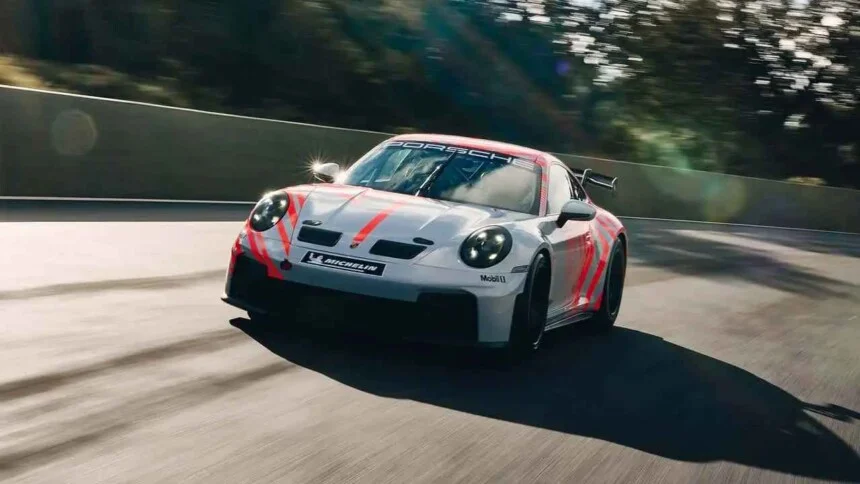
Porsche 911 Challenge Brings a 9,000-RPM Engine and Roll Cage to the Track
Porsche has introduced a track-only 911 built around a naturally aspirated flat-six, serious motorsport equipment and a $275,000 price tag.
Quick Look: The Porsche 911 Challenge transforms the 911 GT3 into a dedicated track machine with 508 hp, a 9,000-rpm redline, a seven-speed PDK gearbox and a full racing safety setup.
Meet the Porsche 911 Challenge
Porsche has unveiled the 911 Challenge, a new track-focused race car designed for drivers who want to experience serious motorsport technology without stepping into the most extreme levels of professional racing machinery.
Based on the road-going Porsche 911 GT3, the 911 Challenge takes the familiar performance formula and removes much of what is unnecessary on a race circuit. The result is a lighter, more focused machine designed around speed, control and driver involvement.
A High-Revving Naturally Aspirated Flat-Six
At the heart of the 911 Challenge is a naturally aspirated 4.0-litre flat-six engine. Porsche has extracted additional performance from the powerplant, with the track car producing 508 horsepower and capable of revving all the way to 9,000 rpm.
The engine is paired with a seven-speed PDK dual-clutch transmission, allowing rapid gear changes while keeping the engine in its ideal performance range. The combination of a high-revving naturally aspirated engine and fast-shifting transmission gives the 911 Challenge a distinctly motorsport-oriented character.
Porsche 911 Challenge Highlights
- 4.0-litre naturally aspirated flat-six
- 508 horsepower
- 9,000-rpm redline
- Seven-speed PDK transmission
- Track-only configuration
- Approximate weight of 1,450 kg including ballast and transport tyres
- Welded racing roll cage
- Adjustable rear wing
A Road Car Transformed for the Circuit
Porsche has removed many of the features that make the standard 911 GT3 suitable for everyday road use. The 911 Challenge does away with items such as airbags, the passenger seat, carpeting and much of the sound insulation.
Those changes help reduce unnecessary weight while making room for equipment specifically designed for circuit driving. The focus is no longer comfort or practicality, but creating a controlled and purpose-built environment for racing.
Serious Motorsport Safety Equipment
In place of the road-car equipment, Porsche has fitted a welded roll cage, a dedicated racing seat and a six-point harness. The car also features a fire-extinguishing system and other motorsport-specific equipment intended for track use.
These additions are important because the 911 Challenge is designed around circuit performance. A dedicated racing cockpit provides the driver with a more secure seating position while the safety equipment is built around the demands of high-speed track driving.
Built for the Track
The 911 Challenge includes a range of details that would be unusual on a conventional road car, including an adjustable rear wing, quick-release bonnet, rain light and integrated air jack. Each feature is aimed at making the car easier and more effective to operate in a motorsport environment.
Weight Reduction Is a Major Part of the Formula
Keeping weight under control is one of the most important elements of the 911 Challenge’s design. With road-car equipment removed and racing components installed, the car weighs around 1,450 kg including ballast and transport tyres.
Reducing weight can benefit braking, acceleration, cornering and overall responsiveness. Combined with the high-revving flat-six and track-oriented chassis setup, the result is intended to provide a much more focused driving experience than a standard road-going 911.
How Much Does the Porsche 911 Challenge Cost?
The Porsche 911 Challenge carries a reported price of around $275,000. That places it firmly in specialist motorsport territory, although its positioning is intended to make Porsche’s racing technology more accessible than some of the manufacturer’s more extreme competition cars.
It is important to remember that this is not simply a road car with a few racing upgrades. The 911 Challenge is designed specifically for track use, meaning its equipment and configuration are focused on circuit driving rather than everyday transportation.
Why the 9,000-RPM Redline Matters
One of the most appealing aspects of the 911 Challenge is its naturally aspirated engine. Modern performance cars increasingly rely on turbocharging and electrification, making high-revving naturally aspirated engines increasingly special.
A 9,000-rpm redline allows the engine to deliver its performance higher in the rev range and gives the driver a more engaging connection between throttle input, engine speed and acceleration. For enthusiasts, that mechanical character can be just as important as the headline horsepower figure.
The BLOG4CARS.COM Take
The Porsche 911 Challenge takes the familiar GT3 formula and pushes it firmly toward motorsport. A 9,000-rpm naturally aspirated engine, 508 horsepower, reduced weight and dedicated racing equipment make it an exciting proposition for drivers who want a purpose-built track car.
Final Thoughts
The Porsche 911 Challenge shows that there is still plenty of room for traditional performance engineering in an increasingly electrified automotive world. Its naturally aspirated flat-six, high-revving character and dedicated racing equipment make it very different from an ordinary sports car.
With its $275,000 price, track-only configuration and serious motorsport hardware, the 911 Challenge is clearly aimed at a specialist audience. For enthusiasts who value high-revving engines, lightweight construction and pure circuit performance, however, it could be one of the most interesting Porsche track cars available.
BLOG4CARS.COM — Your source for automotive news, performance cars, reviews, comparisons and everything about cars.
Join the conversation
Be the first to share your thoughts.
Leave a comment